01 January 2022

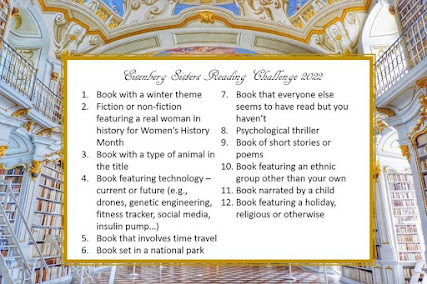
Eisenberg Sisters Reading Challenge

I had a sad, sad year in 2021 and read very few books. I think my mood will do better if I read more, so I'm joining a reading challenge - or two - and hoping this will spur me to turn more pages than I did in 2021. Here's the plan, subject to change:


  1. Winter theme: Spinning Silver by Naomi Novik
  2. Women's History: Hild by Nicola Griffith (a reread)
  3. Animal: The Conference of the Birds by Ransom Riggs or maybe Wolf Hall by Hilary Mantel 
  4. Technology: To Sleep in a Sea of Stars by Christopher Paolini 
  5. Time Travel: Kindred by Octavia Butler
  6. National Park: Wild: From Lost to Found on the Pacific Crest Trail by Cheryl Strayed
  7. Unread Bestseller: The 1619 Project by Nikole Hannah-Jones
  8. Thriller: And Then There Were None by Agatha Christie
  9. Short stories or poems: Felon: Poems by Reginald Dwayne Betts (reread)
  10. Other Ethnic: Moon of the Crusted Snow by Waubgeshig Rice
  11. Child narrator: The Book Thief by Markus Zusak 
  12. Holiday: Letters from Father Christmas by JRR Tolkien

28 June 2012

Co-sleeping for yiddish policemen

I recently read the Yiddish Policeman's Union, and once in a while I am reminded of something from the book. Tonight we watched Jim Gaffigan's Mr. Universe and Gaffigan's description of his children's nighttime visit to his marital bed had me chortling. After laughing for a while I was able to search for and find the reference:
"The Shemets boys set up a whistling and rumbling and a blatting of inner valves that would shame the grand pipe organ of Temple Emanu-el ... They chop at Landsman, stab him with their toes, grunt and mutter. They masticate the fiber of their dreams. Around dawn, something very bad happens in the baby's diaper. It's the worst night that Landsman has ever spent on a mattress, and that is saying a good deal."
That sounds about right. I wholeheartedly recommend both the book and the comedy special.


06 July 2011

The Hated 15: Theon Greyjoy

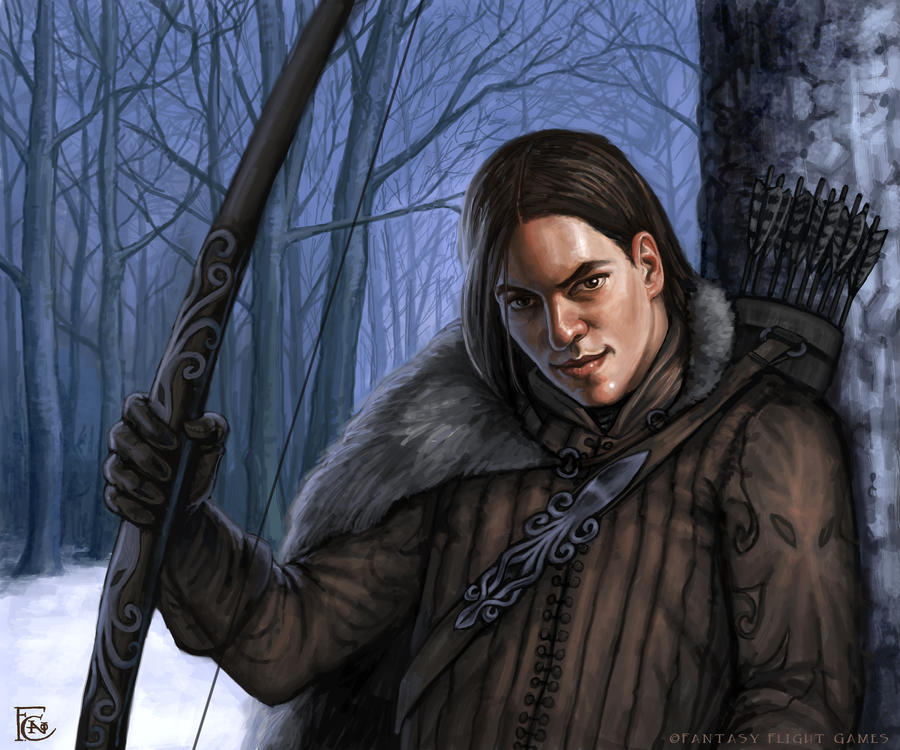
At Towerofthehand.com, there's a lively community of science fiction/fantasy fans that gather to discuss the Song of Ice and Fire series by George R R Martin. Occasionally featured are essays by members; recently one of mine was selected for a countdown of the most hated characters in the series. (I've posted some other essays on ASOIAF before also). I present: Theon Greyjoy. Warning, spoilers follow.
Theon Greyjoy, Theon Turncloak (Artist: Felicia Cano)
Mercy is rare for the children of Westeros. None was to be had for Barra, King Robert's bastard girl. Even high-born children are prone to be victims, as Rhaenys and Aegon Targaryen attest. Rebels and dis-respecters are treated particularly harshly, as shown in the treatment of the Reynes of Castamere - the entire house extinguished, every man, woman and child. The least likely place one would expect mercy would be the cold, hard North - yet this is where the son of the leader of the Greyjoy Rebellion is brought and cared for, raised alongside the noblest children of the region as their peer. He is a hostage - but the cage he is kept in encompasses Winterfell and the lands it governs (including a brothel nearby). He is out of place there, treated suspiciously by many, and never completely accepted. His time with the Starks easily looks like a fostering, which is within the traditions of the Seven Kingdoms, but to his native lands it is not understood that way. Theon Greyjoy rises in position to become a trusted companion of the King in the North, Robb Stark.

But fostering, as with other traditions of the Green Lands, is no right place for an ironborn man. Theon is gradually changed through this proximity to the Stark children to be more like his enforced companions, less like an Ironborn. His sense of his native culture is so far eroded that he undertakes to negotiate with his father on behalf of King Robb, never recognizing that his father would see him as forever suspect in such an arrangement. The glaring errors of his assumptions are displayed for his father at the worst possible moment when Lord Balon asks:
"That bauble around your neck - was it bought with gold or iron?"
Theon touched the gold chain. He had forgotten. It has been so long... In the Old Way, women might decorate themselves with ornaments bought with coin, but a warrior wore only the jewelry he took off the corpses of enemies slain by his own hand. Paying the iron price, it was called. A Clash of Kings: Theon I

In that exchange, the father remakes the son. But when does a child become a man, and responsible for the repercussions of a man's choices? Theon again is scrambling to find a place for himself - recognizing finally that he is no prodigal son coming home, but in his father's eyes he is corrupted to the soft life. Corrupted and corruptible; Balon recognizes that if Theon can be turned into an emissary for the Starks, he can be turned back against the Starks, to prove himself ironborn or die trying - either way relieves Balon of the troublesome prospect of a son who is a misfit. Balon, of course, doesn't recognize that it is his grasping, unrealistic ambitions that resulted in the surrender of his son.
Theon accepts the challenge from his father and sets out to out-ironborn the ironborn, and this is when he changes from being a self-centered, naive and selfish boy to a conniving, backstabbing man. He accepts charge of a small force of men and is charged with creating some mayhem on the Stony Shore. And, much like his father's ambition to make a place for himself he overreaches for Winterfell - and, surprising us all, he succeeds.

This dual betrayal - of Balon's orders, and Robb's trust - gets Theon quite a ways down the road to being hated by the reader. Then he compounds our reader's misery, slaying children to further his scheme and mistreating Winterfell's people. It is almost a relief when Winterfell is lost to Theon, and Theon is captured by the Boltons - but the cost of Theon's comeuppance is the razing of Winterfell and that seems too high a cost. This, too, we blame him for - that Winterfell, centuries old, should be ruined due to his recklessness makes us hate him more.

Is redemption possible for such a flawed soul with such mistaken motives? For a man who cannot be grateful that he was warded instead of slain, who can't be true to his friend, who mistreats the women around him, who cannot satisfy his father, who is responsible for the deaths of children and the destruction of the Starks' home - what hope have we? What hell would Theon have to survive, what right acts could he perform as penance? A Dance with Dragons might offer the chance for redemption and an escape from his hated outsider status (certainly Theon must be punished - how much is sufficient?) - or it may make us hate him all the more. I hate to leave the choice up to Theon, as he makes such poor choices. Is he ready to choose, to join the game again?
01 July 2011

Dogsbodies and Scumsters by Alan McCormick and Illustrated by Jonny Voss

Quirky tales of ne’er do wells and washouts strive side by side with poetical furniture and terminally ill wives in this short story collection. I found the characters endearing and whole in the sketches of these fractured souls and recommend the series to any who delight in witty, bite sized fiction that grows more worthy upon reflection, even as it captivates you during the read. Roast books has excelled again in putting forth this new author for their readers and fans; where do they find these story tellers? If I were to ask McCormick, perhaps he could spin a tale of the underground vat where he was grown on a diet of hearty adjectives and high-protein nouns. I’ll highlight two stories that were favorites in this collection, and leave you, reader dearest, to enjoy the rest unprepared as I was.

“Deal or No Deal” is Brenda’s tale, and Brenda is a very pitiful creature. The story opens mildly, with the socially awkward girl struggling to understand her sister’s harrangues, handle the insults of her bratty niece and nephew and understand her grocer’s friendliness which is just as confusing to her as the nastiness she endures from her family. I was completely caught up in pity for her, an apparent  lost soul. And then, as she goes through her day making tea and watching a game show in the company of her neighbor, her past slips out in dribs and drabs until suddenly the pity switch flips back to neutral. I didn’t suddenly feel that her family was right to be nasty to her, but I could understand why they were. That McCormack could get me to flip by judgment in 6 pages of concise text is a cunningly efficient maneuver which left me a bit wobbly in my reading parts.

“Storyteller” finds Katie careening through her life at a fast pace, following a bomb blast. As she unwinds the knots of her tangled tale her patter becomes less and less assured, her poise starts to slip. She lives a mendacious life, and she knows it, justifies it, and celebrates it. She never apologizes, and  doesn’t entertain the possibility that there’s another honest way of living – at least not for her. But how far would she go to protect her carefully structured identity? And if not apologetic, is she vindictive towards those who she believes set her on the lying path? 

In coming weeks, I’ll be on stage for improv again and am sorely tempted to bring to life on stage some of these irascible, weirdly bewildered characters – I can imagine Katie, in a Grace Kelly scarf patiently explaining herself to a reporter with mounting anxiety. Brenda could easily appear on a bus, riding along in silence and needing a retreat from the world with to trouble her. I wonder if McCormack would be willing to let me let these dogsbodies onto the stage- or if they are better kept in a jar, in a lab, underground, and away from the light of day.

01 January 2011

6 books for 2011

I have quite a backlog on my books-to-read list, and this holiday season has brought a few gift books (thank you!) which I am looking forward to reading. Also, the the last two boxes of books from the move 18 months ago have finally been unpacked, revealing old book friends of mine that I'd like to revisit. Here's my list, with explanations - do you have yours?
Origins: How the Nine Months Before Birth Shape the Rest of Our Lives
    RemakeSpeaker for the Dead (Ender, Book 2)An Edible History of HumanityThe Dragonbone Chair (Memory, Sorrow, and Thorn, Book 1)
  1. A Dance with Dragons by George R R Martin. I've been a member of a fan site, Tower of the Hand, and we're going on years now of lengthy re-hashing and re-analysis of the previous books. I preordered it 2 years ago.  Now we're a little more upbeat since HBO is producing the Game of Thrones series but still, it has been quite a wait. Please, George, finish the book and make 2011 the year it happens. Hint for fans: if you like the books, and want to talk with like-minded folks, visit Tower. If you just want to rant about the delay, go to FTBG. 
  2. Remake by Connie Willis. Willis is a favorite author, but somehow I forget about her from time to time. Recently I recommended two of her books, Doomesday Book and To Say Nothing of the Dog. it occurred to me that I would like o be more familiar with her additional works, as I liked these so well.
  3. Origins by Annie Murphy Paul was recommended to me by my friend Tracey, undisputed intellect and wise mother. Her book recommendations I do not second-guess.
  4. Speaker for the Dead by Orson Scott Card I have to read this year as my eldest is  starting on Ender's Game. My mother, when I was younger, made a point to be familiar with all that I was reading and as a result we had something to talk about in those awkward teenage years. I hope to follow her example.
  5. The Dragonbone Chair by Tad Williams -  was recommended to me by fellow readers who enjoy the Song of Ice and Fire series, so I figure to give it a go.
  6. An Edible History of Humanity by Tom Standage - received as a holiday gift, and interesting from a historical sense.

My goodreads list has additional books, hopefully I'll get to a few more of these in 2011.
Eva's bookshelf: to-read


Atlas ShruggedPhoenixBrokedown PalaceTo Reign in HellAthyraOrca

More of Eva's books »
Eva's to-read book recommendations, reviews, favorite quotes, book clubs, book trivia, book lists

30 December 2010

Thousands of leaves from a thousand autumns

KYOTO, JAPAN - DECEMBER 04:  Togetsukyo Bridge...Image by Getty Images via @daylife
Today the snow is melting in Indianapolis and it reminded me of a book I'd read but not blogged about yet: The Thousand Autumns of Jacob De Zoet by David Mitchell. This book takes a compelling historical incident involving the Dutch East India Company's trading post on the island of Deijima, their limited actions with the Japanese, and the appearance of an English ship in the harbor.

The story begins initially with a young Japanese medical student, Orito, a woman of noble birth who has a face scarred from burns. She faces a kidnapping, forcible drugging, and forced service before attaining some redemption later, and on her own terms.

Orito gains the attention of Jacob De Zoet, a young man seeking to make his fortune with the Dutch East Indies Company before returning home to Zeeland.  Jacob is struggling to live morally in this outpost far from the stolid community he comes from, amongst men of uncertain character. As he wrestles with his conscience, he is punished for each decision he makes which is right. In a pivotal scene, his ability to persevere in a course he deems right is essential, though, and serves to keep the Dutch flag flying in Dejima for the years when the Dutch flag was flown nowhere else in the world.

A third character, Uzaemon, offers the last leg of the love triangle. He is a translator and scholar, and moves in waters with deep predators whose cunning he cannot fully see. The outcome, while sad, was predictable.
The Thousand Autumns of Jacob de Zoet: A Novel

The historical background research for this work must have been extensive, but the author's burden is not onerous to the reader.  Instead the international dynamics between English-Dutch-Japanese percolate along slowly and unobtrusively, until boiling over such that the characters react with precision. I admire Mitchell's ability to use such rich historical narrative without letting it overwhelm the fundamental story.
Enhanced by Zemanta

28 December 2010

The fast gourmet cookbook

The fast gourmet cookbook by Poppy Cannon

5.0 out of 5 stars Simple genius in the kitchen, December 28, 2010
This cookbook was a wonder-trove of information on how to pull together an apparently-from-scratch gourmet meal using readily available products and items from a local store. I'm shocked that this book isn't more widely available as her recipes are wonderful for use by busy cooks in any age, who want to serve something better than take-out. The recipes are varied and multinational. As an example, she has a tasty recipe for black-cherry chicken that uses a grocery-store rotisserie chicken, marjoram, and a can of black cherries to make a wonderfully savory dish in less than 10 minutes. If I had only two cookbooks ever I would have Joy of Cooking: 75th Anniversary Edition - 2006 and this book from Poppy.

13 December 2010

Bran Stark featured at Tower of the Hand

The stone is strong, Bran told himself, the roots of the trees go deep, and under the ground the Kings of Winter sit their thrones. So long as those remained, Winterfell remained. It was not dead, just broken. Like me, he thought. I'm not dead either.” - Bran VII, A Clash of Kings
Bran Stark from HBO's Game of Thrones

In the North, for ages gone and many winters past, it appears that change comes not often. The Starks rule the North a thousand miles from King’s Landing to the south; their castle has stood for 8,000 years since it was raised by Bran the Builder. The cold lands lead to a staid people, unlikely to change often or easily - or so we would expect.


Not all is as it seems. Certainly not for a winter-lands child who can name his wolf Summer.


The Starks have wolf-blood,  even down through the last Stark in Winterfell - Bran the Broken. Bran’s capabilities are unknown to him, though, until he is crippled, by Jamie Lannister, when Jamie shoves Bran out a high tower window.  Bran spends weeks in a coma, watched over by his mother, Catelyn Stark, and guarded by Summer (and perhaps kept alive by the direwolf as well) - though the extent of Summer’s efforts are unknown until the wolf stymies an assassin.


Summer and Bran become closer still as Bran wakes from his coma and develops his warging abilities. Soon Catelyn heads South, Robb rides to war and Bran takes command of Winterfell, meeting with the Stark vassals and planning with his advisors for winter. He frets the whole time though that he will never be enough for the role; that as a cripple he is washed up. His dreams of knighthood evaporate, and he mourns their loss. How pitiful to see a child facing losses that would undo even a brave man. Fortuitously, then, the Reed siblings arrive to guide him, protect him, and shepherd him to a new life beyond the wall, to the three-eyed crow. Bran sets aside his childish dreams for truer dreams..


Westeros is changing - the North is changing - and who better to lead the North than a boy who can change not only his dreams of knighthood but even his very skin? Superficially, he is a paralyzed boy unable to sit a horse without a special saddle - but once we move beyond the surface of things, we find a boy who can be a giant with an unorthodox batte-cry of "Hodor!" or a wolf with an intelligent gaze. While there is some debate as to whom Robb Stark may have named as heir, or whether Jon Snow could accept and hold Winterfell, there is no debate as to who the last Stark was to sit in the high hall; that was Bran.  It was he also that knew Winterfell in and out, from up and down, and knew its passages and walls better than anyone. Bran has long odds to beat in just surviving in such a harsh land. But if you are already known as dead, perhaps survival will be easier.There is not much room for cripples in Westeros at war anyway.


Bran's fall and survival presages the fate of the Starks; they will fall, but rise again, fundamentally changed. Bran’s fate awaits him beyond the black gate with Coldhands; “the Black Gate, Sam had called it, but it wasn’t black at all.” Of course it wasn't black. Nothing, in this unchanging land, is really what it seems.

---
This post published at Tower of the Hand as part of the Top 30 Characters profiles on 12/7/2010. A previous character profile on Oberyn Martell was published on 11/22/2010.

22 November 2010

Oberyn Martell profile featured at Tower of the Hand


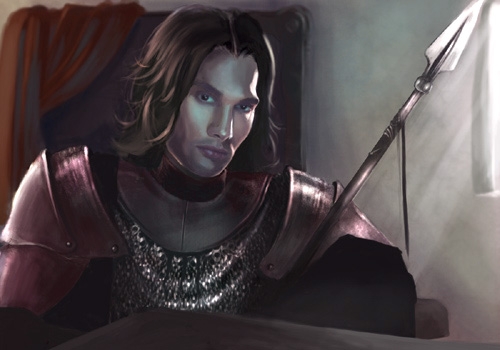
Oberyn Martell is the heart’s desire of many a lady in the Seven Kingdoms, and the heart’s bane of many a lord. The earliest conquest the reader knows of results in a duel between 16 year old Oberyn and Lord Yronwood over the affections of Lord Yronwood’s lover, and it does not end well for the Yronwoods with their Lord dying of festering wounds. Could these wounds have festered from some additive on Oberyn’s blade? He never claimed that, but earned the name Red Viper for the rumor.  His amorous ways have resulted in fine rewards for him; eight daughters, all in good relations with their father.

Oberyn Martell, the Red Viper (Artist: Natascha Roeoesli).
The oldest four of these sand snakes have different mothers. And why would they not? Oberyn took a partner in each place he took himself, and his daughters reveal the diversity of the man. The eldest was born to a whore of Oldtown. The next to a noblewoman across the ocean in the free cities. Third born was to a septa, who are generally a chaste lot. Fourth was to a Summer Isles trader. Most of the Westerosi abide by class distinctions without remark; Oberyn, instead, moves amongst all these groups with ease, and not just superficially - but with enough engagement to form relationships and keep them even after his affections have moved on. Oberyn’s parental devotion assures that even the lowest-born of these by-blow girls are raised into trades and cared for. Contrast that with another man known for his bastards, Robert Baratheon. Robert’s bastards are fathered and killed off in the very city where he sits the throne, and he is ignorant of their demise. One doubts that Oberyn would have let any of his daughters face such malice unprotected.  Notably, Oberyn’s wandering lusts find harbor in one woman: the mother of his fifth daughter, and all those thereafter: Elia - namesake, one assumes, of his deceased sister.

Oberyn’s protective instincts for his daughters likely arose from Oberyn’s one failure to protect those he loved: his sister Elia, and her children. Was his beloved sister Oberyn’s first lover? We readers are left to wonder. Oberyn convinced his elder sister to reject all the Dornish suitors their ruling mother brought for consideration; so impossible was a Dornish match, the siblings were sent to Casterly Rock to meet the Lannister twins as an alternative. I speculate that Joanna Lannister and the Princess of Dorne in their close friendship had shared concerns about their children’s too-close relations, and it was decided between them to make the best of it by throwing the four of them together into arranged marriages and letting them pair up as they saw fit. These plans, if such they were, were derailed at Joanna’s death and superseded by Tywin’s dynastic ambitions to make Cersei queen. Certainly Oberyn believes that Tywin bore his sister a grudge when she took the place Tywin expected for one of his own.

Tywin’s grudge was a little thing though compared to the tenacious lust for revenge that grew within Oberyn after the sack of King’s landing - but that was years away for the young Oberyn. Oberyn did not take a partner when his sister married Prince Rhaegar; perhaps, like Jaime Lannister, being brother in law to the king was enough for him. Was Oberyn as devoted to Elia as Jaime was to Cersei? Apparently not, as unlike Jaime, Oberyn was off on his adventures (amorous and otherwise). And what friendship did Oberyn have with his brother-in-law, Rhaegar? Did they come to some understanding that allows Oberyn to forgive - or even facilitate - whatever happened between Rhaegar and Lyanna? Note that as much as Oberyn rages against the Lannisters, he has no venom for Rhaegar, who left Elia and her children undefended.

While Oberyn was away - in pursuits unexplained and unaccounted for - his sister is raped and murdered and his niece and nephew are slaughtered by Gregor Clegane, a guy who enjoys this kind of thing. Oberyn, once back on the scene, rallies Dorne to call for revenge; his brother Prince Doran receives a visit from Lord Arryn which halts the effort. Tywin, in response to accusations from Dorne, frustratingly has plausible deniability in that he contends he did not order Elia’s death, he merely neglected to put orders in place to prevent it. And thus Oberyn’s resilient heart grieves.

Being a Martell, his heart is not broken - Oberyn’s family words provide solace - unbowed, unbent, unbroken. He hones his grief into an instrument of vengeance directed at his sister’s killer and bides his time, waiting patiently until the opportunity presents itself. When it does, with an offer to join the Small Council and get justice, he eagerly accepts. Once in King’s Landing, Oberyn will not set aside his need for revenge - and the longer he hears the Lannister’s futile efforts to placate him, the more impatient he becomes. When the chance comes for him to find justice in defending Tyrion Lannister, he takes it.

Oberyn’s patience reasserts itself during the duel. He steadily whittles away Gregor’s strength, seeking a confession - he taunts his adversary repeatedly: "You raped her. You murdered her. You killed her children." The incessant patter, a’la Inigo Montoya’s in the Princess Bride, grates on the Mountain and, unbelievably, unsettles him from what would assume is a calloused moral state. The duel between them is epic; the fast-moving, acrobatic and deadly accurate poisoner matched against the brutal strength and defensibility of a heavily armoured knight with no ethics. A reader could be forgiven for getting caught up in the scene, believing vengeance would be served in just fashion, and an unrepentantly evil character would receive an overdue comeuppance.  Alas, this is George Martin and such tidy conclusions are not for his readers. Oberyn manages to pin Gregor like a bug on a collector’s board, yet despite this Gregor rallies and brutally crushes Oberyn’s face with his hand, confessing at the last that Elia had the same treatment from him.

Oberyn is a man whose life was defined by the women he loved; his mother, his daughters, his lovers, his sister.  By all rights he was expected to die happily in bed with a woman. Instead, he has a warrior’s death from a hateful man, unlikely to have heard the confession he died to extract.

This post published at Tower of the Hand as part of the Top 30 Characters profiles.

31 October 2010

Water for Elephants by Sara Gruen

Water for Elephants: A NovelAny novelist who can turn the reader's ignorance to advantage has my respect; Sara Gruen does it by using the reader's ignorance to highlight the wet-behind-the-ears naivete of her protagonist, Jacob. She also turns the reader's forgetfulness to advantage, letting the protagonist's uncertain remembrances guide the reader through the story.

I read Gruen's novel Water for Elephants about circus life this past summer, it was a lovely summer read. The story follows Jacob Jankowski's memories of his life as a young man. In his memories, he is transitioning from a young man's college life to a life on the road as a traveling vet for a circus; in the present time of the novel, he is an old man transitioning gradually into extreme old age.
His memories start with his veterinary school; due to a traumatic event, Jacob leaves his final exams unexpectedly. It is the peak of the great depression, and every option he considers stymies him.  He runs away and joins the circus, and encounters a cast of characters that live a double life. On stage, they are marvelous and beautiful, consummate entertainers and work as a well-oiled machine to make sure the show goes on. Off stage, they are just as misfit as is Jacob.

Some warnings for the squeamish: the animal brutality is, well, brutal. Some reviewers have said that these events occurred 50 years ago and don't represent a modern aesthetic; I think that's counter-factual. Consider for example the Humane Society's campaign against bear baiting. PETA has also documented cruel practices that exist today for elephants in circuses. Gruen's descriptions of circus animal treatment are thus relevant today.

Gruen's careful research into circus culture and the history of the depression gives veracity to the tale; the details of jake leg poisoning especially and its impact on the afflicted was well done.  Also relevant is Gruen's sympathetic description of Jacob and his predicament in the nursing home. He wants to have the respect and self-sufficiency that he earned for himself in the circus long ago; instead with his physical infirmities, memory trouble, and depression he recognizes his decline. The parallels between his young self - seeking love, acceptance, and control over his destiny - and his older self, seeking the same, are apparent upon reflection.

The story itself is touching and ends well; Jacob reclaims his autonomy and is on the road again.  Marlena's character is fiery and understandable as a love interest for Jacob; and Rosie herself, as expected, steals the show whenever she is on scene. August works exceedingly well as a sympathetic villain, in a twirly-mustachioed kind of way.

P.S. The author developed this work as part of the NaNoWriMo effort, which I find delightful. The project asks participants to start writing a novel on 11/1 and finish by 11/30 - many have parlayed National Novel Writing Month efforts into a published work. I keep daring myself to try it, and my pitiful excuses for not doing it are shameful. But seeing what Gruen accomplished in her month keeps me wondering if I could do it.

Take a look at the trailer for the upcoming movie also for more circus glamour:

Enhanced by Zemanta

28 March 2010

Snark by David Denby

How does one address an audience in a witty and humorous way while avoiding snark? This is an essential writing talent, very useful to those dealing with the loyal opposition or even hecklers. Denby's book seemed positioned to help resolve this - but doesn't. Unfortunately, as much as Denby attests to the ultimate ineffectiveness of snark - the writing feels snarky. The examples provided, ranging from Juvenal  to Pope to a discourse on modern internet discussions, are conveyed in a slightly offhand, smarter-than-thou manner which is off-putting rather than engaging. For example, from David Denby:
"when reading Juvenal - which is quite an experience, rather like getting drunk during an obscene night in a comedy club..."
And here's a quote from Juvenal to ponder:
The blind envy the one-eyed.
And here's an example you might hear getting drunk during an obscene night in a comedy club:


Juvenal = Carlin? Absolutely not. Denby's pushing some snark at us in the guise of explaining how snark is deteriorating civil discourse and reducing our ability to understand and relate to one another's ideas. I think the argument would have been furthered more readily by not using snark to make the case that snark was not as useful. And I'm not trying to be snarky in saying that.

I think the author has a good point to make. In describing the master snark-users and regaling readers with tales of the utility of snark for their situations, Denby provides a service. A thriving counter-culture and critiques of power are essential for the  healthy functioning of democratic societies, so understanding better the ways in which master political critics rise to their talents would be useful.

And, to end on a minor complaint - I would have appreciated a clear definition of what he considers snark. There's no proffered definition, no attempt at such - and thus, one man's snark is another man's measure.

18 February 2010

The fate of humanity depends on Shakespeare.

Reading Muse of Fire by Dan Simmons is a glimpse behind the scenes of a horrid future, and backstage of the workings of the universe. Dystopian novels of a world undone compel me to read them; a story of a whole metaverse gone haywire was irresistible.Muse of Fire

The story is narrated by young Wilbr, an actor with The Earth's Men, a traveling performance troupe that specializes in Shakespeare. Their travels take them from planet to planet, entertaining the enslaved humans who toil for their alien overlords, the Archon, a race so alien they seem to take no notice of the humans, except for their work output. Suddenly and for no apparent reason, after a performance of Much Ado About Nothing, the alien's interest manifests itself for a performance request. The performers oblige with the Scottish Play. And then, the overlords of the Archons appear with a request for a performance of their own...

William ShakespeareBy the end of the tale, the performers have given the performances of their lives, and perhaps more than that: they are told that the continued existence of humanity depends upon their skill. Have they passed the test? Or was there any test at all - was the outcome predetermined?


Reblog this post [with Zemanta]

11 February 2010

The Puzzle Ring by Kate Forsyth

I recently finished reading The Puzzle Ring by Kate Forsyth. She's an author I wasn't familiar with before, and I'm glad to have met her through this blog tour. For other stops on her blog tour, check out the list The Bookette helpfully put together.

The novel concerns protagonist Hannah Rose, who discovers by accident that her mother had spirited her away from a birthright in Scotland. The strong willed lass immediately demands that her mother return her to Scotland, and succeeds. Hannah then begins a relationship with the great-grandmother she didn't know she had; she investigates the mystery of her father's disappearance; and she sets out to break a curse that's doomed her family for over 400 years... which takes her back to that very time.

As a girl raised on tales from Nancy Drew and C.S. Lewis, the cadence of the story and the reliance on a child to do the work of an adult were a comfortable fit for me. I'd recommend the story for any young girls interested in the supernatural, especially if it keeps them away from sappy vamp lit. The plethora of mythical and magical creatures - selkies, blue men, imps and the Unseelie Court - reminds me also of Marion Zimmer Bradley's Mists of Avalon,

I particularly loved the portrayal of the past as not a romantic tourist promenade, but a dangerous and uncouth time in which people lived very differently than we do now; eating rarely, and storing clothes near the toilet. As a traveler to the past, Hannah's reflections on the distance separating her from her present and on how terribly her manners suit the time she finds herself in are beautiful expositions which further the story. These reflective moments on Hannah's part also serve as proxy to her transition from childhood to adult.

Thanks Scholastic for the review copy, and thanks Kate for the time for the interview!

I asked a few questions of Kate Forsyth to better understand the book:
Scottish history is, like that of many countries, full of bloodshed and horror as well as heroes and glory. How much did you think about representing both aspects of this history - the proud moments and the desperate?
It was very important to me to try and make the history seem as real as possible. One of my strongest dislikes has always been fantasy that sets its story in a quasi-medieval world that somehow does not smell like medieval times. I think fantasy must be rooted very deeply into the real if it’s going to work well. There’s always a balancing act between keeping the pace moving strongly and giving enough vivid detail to bring the world and the times to life, and so I hope I managed to keep all the balls in the air. I wanted to show just how very dangerous it was for Hannah and her friends to go back in time, because the world of the 16th century is far more barbaric, ruthless and fraught with danger than the world of most middle-class teenagers today. Also, for me, it was important to show both the high points and the low points of the story of Mary, Queen of Scots, herself. Her story is so compelling and so tragic because there is such a contrast between her days as the most beautiful and powerful women in the world and the end of her life as a poor captive who has her head cut off by her cousin.


There are a few subtle references to elitism in the book; for example, Hannah's mother Rose is unhappy by the way her mother in law treats her household help, and scorns the prospect of taking on the title she is entitled to by marriage. After a few references to this, though, Roz never mentions it again. I'm left with an impression of her character as being somewhat indecisive. Can you speak about this characterization of Roz?

I certainly don’t see Roz as a particularly forceful character – she gives in to her daughter Hannah on almost every front – but I also think she had a very hard time, losing her husband when Hannah was only a day old and living in a house in which she felt like an outsider. I think Roz was always rather overwhelmed by the Countess of Wintersloe, who is a very strong personality, and who, besides, believes in all sorts of strange uncanny things that Roz believes firmly to be complete and utter rubbish. The two are diametrically opposed which makes for great conflict. I think that Roz is gradually won over by Lady Wintersloe, and by the warm and loving relationship she has with her cook, and by the magical atmosphere of the house itself. Roz went to Wintesloe Castle very reluctantly – she had sworn never to return there – but after a while she stops protesting so much and by the end I think she is glad to be there.
The scenes written with Queen Mary were fabulous; I loved the contrast of her as the glamorous life of the party with her later appearances, crying and captured. I admired very much how you distilled what is a long and complex tale of her life into very few references that still gave substance to her character, and provided interest without overwhelming Hannah's tale. Are there other historical subjects you would like to cover in future stories?
Mary, Queen of Scots in "white mourning"Oh, absolutely! So many stories of the past that intrigue me. In my earlier novel, ‘The Gypsy Crown’, the action is set during the English Civil War which was just as fascinating and dangerous. All the action takes place in the last three weeks of Oliver Cromwell’s life, and I’d love to write a sequel to that which looks at England in the time of the Great Fire and the plague. Then, I’d also love to write more Puzzle Ring stories – I can see Hannah and Donovan and Max and Scarlett meeting Bonnie Prince Charlie ... or perhaps being caught up in the Highland Clearances, a time of great grief and trouble ... or even, perhaps, helping Robert Louis Stephenson come up with the plotline of ‘Kidnapped’ ... I have so many ideas!
I previously read Diana Gabaldon's Outlander and enjoyed the time travel and magical elements in her writing, but they were much more in the background of the story rather than being center-stage as they are in The Puzzle Ring. Is there something about Scotland that is drawing such literary attention?
Scotland is a storyteller’s dream. So much history, so many fairy tales and battles and love stories and ghosts. I was brought up on them all, thanks to my Scottish forebears, and love the idea of bringing some of them to life. Why are stories set in Scotland so popular? Perhaps because there are so many people, scattered all over the world, who have Scottish blood in them. Perhaps because it still seems like a wild, lonely, mysterious place when so much of the world is built over with cities and fast food joints. I don’t know - I only know that I love to read books set in Scotland!
I would have really enjoyed this story when I was a tween - it would have fit right in with my collection of Jane Yolen and Narnia books. Reading it as an adult, it seemed like a very feminine book; there's few men in Hannah's life, she concerns herself with "typical" girl concerns of hair and makeup and fashion, and her dynamics with Scarlett aren't ones I've seen my sons endure with their friends. Do you think a boy might enjoy this book as much as a girl, and why?

I’m glad you enjoyed the book and I love you comparing it to Jane Yolen & C.S. Lewis as they are two of my all-time favourite authors!

I’m intrigued, though, by your comment re the femininity of the book. There are as many boys as girls in the story – Hannah and Scarlett versus Donovan and Max – while Hannah’s father and the old gillie Angus help balance out the Roz/Linnet/Lady Wintersloe triangle. And I don’t really see Hannah as being very interested in hair and makeup and fashion at all – I think Scarlett is, definitely, but Hannah very much goes her own way. Apart from liking to wear a beret, of course.

I do like the idea of both boys and girls reading my books. I remember when I was a child, my sister and my brother and I all read the same books and we all played the same games – pretending to be in Narnia, or to be the Famous Five, or having sword fights in the back garden. I worry about the modern trend to write books about princesses and fairies for girls, and spies and gadgets for boys – children that don’t read the same books and play the same games will not have an imaginative landscape they can share. Certainly lots of boys read my books, because they come along to my public appearances and ask me questions and bring their books for me to sign. Though now I come to think of it, I get a lot more fan mail from girls!

Reblog this post [with Zemanta]