Still waiting. Trying to be patient.
Related posts:
13 June 2009


10 June 2009
A Parody of Writer's Almanac, by request

In 1988, the manga received an "Excellent Prize", narrowly edging out other contenders who had to settle for the "Pretty Good Prize" and the "Something I'd Read After I Finished the Back of the Kleenex Box Prize".
Be average, do some work, and keep your hands where I can see them.
Thanks for the suggestion @ToriFan247.
09 June 2009
Sarny
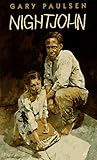
I reviewed Nightjohn by Gary Paulsen earlier this year and was really impressed with i t. I think that dealing with such a subject as slavery in a way that is approachable for younger readers and truthful is a gruelling challenge for an author, yet Paulsen does so admirably well. (See the publisher's author page for more info on Paulsen and his many historical works.)
I got a copy of Sarny for myself to find out what happens after the events of Nightjohn. In the course of the story Sarny matures, becomes a mother, a widow, and then a heroine as she unshackles herself and pursues her children, who have been sold away from her. Her pursuit of her children with her friend and fellow ex-slave Lucy in tow to assist was gut wrenching for a mother to read; and the friendship she had with Lucy was a good counterbalance to the pathos of finding missing children. In the course of events, Sarny learns more about privilege and the reliance she can have on a community than one would normally expect from such inauspicious beginnings. There is a Forrest Gump quality about the way Sarny ends up in the midst of historical events; though gratefully the author does not push it so far as to lose credibility, and also fortunately Sarny is far too smart to settle for Gumplike platitudes in describing her fate. She does offer a few gems of wisdom:
 Again, I read the book rapidly - in two sittings, as the story is so compelling. The setting of New Orleans was a brilliant one, as such a cosmopolitan city provides excellent contrast to Sarny at the start of her time there. I would have enjoyed learning more about Sarny's benefactor Miss Laura, and thought that featuring such a character in the story was both a risky and rewarding choice. My understanding is that Paulsen created these composite characters to represent an amalgamation of persons who would have existed at the time, and that there actually was no such person as Sarny. However, understanding and empathizing with Sarny is a valid way of understanding the historical period and the terrible legacy of slavery for an individual such as she.
t. I think that dealing with such a subject as slavery in a way that is approachable for younger readers and truthful is a gruelling challenge for an author, yet Paulsen does so admirably well. (See the publisher's author page for more info on Paulsen and his many historical works.)I got a copy of Sarny for myself to find out what happens after the events of Nightjohn. In the course of the story Sarny matures, becomes a mother, a widow, and then a heroine as she unshackles herself and pursues her children, who have been sold away from her. Her pursuit of her children with her friend and fellow ex-slave Lucy in tow to assist was gut wrenching for a mother to read; and the friendship she had with Lucy was a good counterbalance to the pathos of finding missing children. In the course of events, Sarny learns more about privilege and the reliance she can have on a community than one would normally expect from such inauspicious beginnings. There is a Forrest Gump quality about the way Sarny ends up in the midst of historical events; though gratefully the author does not push it so far as to lose credibility, and also fortunately Sarny is far too smart to settle for Gumplike platitudes in describing her fate. She does offer a few gems of wisdom:
"The brain don't forget," Sarny says in reflection upon her life; her characterization is completely unforgettable.
Again, I read the book rapidly - in two sittings, as the story is so compelling. The setting of New Orleans was a brilliant one, as such a cosmopolitan city provides excellent contrast to Sarny at the start of her time there. I would have enjoyed learning more about Sarny's benefactor Miss Laura, and thought that featuring such a character in the story was both a risky and rewarding choice. My understanding is that Paulsen created these composite characters to represent an amalgamation of persons who would have existed at the time, and that there actually was no such person as Sarny. However, understanding and empathizing with Sarny is a valid way of understanding the historical period and the terrible legacy of slavery for an individual such as she. 21 May 2009
Anathem by Neal Stephenson
 Anathem
 by Neal Stephenson took me a bit to get into; the author presents a non-Earth world called Arbre with a new vocabulary, social structure, and cultural norms in such a way that one must immerse in it or walk away.
Anathem will reward Stephenson fans, as it requires a devotion to complex plots... and a bit of tolerance. The first few chapters are slow going. But it is worth one's while to get through them. The device of having avout, a type of quasi-monk who lives a life focused on learning rather than worship, learning the secular world via their interactions with the populace provides a graceful way of explaining the secular world without too much tedious exposition. As an example, Simone, a technologist of Arbre, becomes more understandable as the plot advances, and the main character, Ras of the avout, gains an understanding of the world around him.
Having slogged through the opening chapters, I was rewarded by the story that unfolded. This book at this point is my favorite read of 2009. And unless George Martin finishes up A Dance with Dragons or Neil Gaiman comes out with a new masterpiece to surpass the Graveyard Book, I fail to imagine a contender that might take its place.
"The greatest difficulty, for one such as you, shall be, not completion of the given tasks, but instead the humiliation and uncertainty that arises from not being able to know the entire plan. These emotions can hamper you. You must simply decide now, either to proceed with the awareness that the entire plan might never be revealed to you, and, were it revealed, might have obvious defects; or to turn away and allow some other person to occupy [the place] that has been alloted to you." Fra Osa of the Vale
Some fans were even so inspired as to create a trailer for the film of Anathem. Not that tehre is a film version of Anathem, at least not in this version of reality we're in (or this narrative, as Fra Jad would say).
The World of Anathem


 Posts
Posts


