Oberyn Martell is the heart’s desire of many a lady in the Seven Kingdoms, and the heart’s bane of many a lord. The earliest conquest the reader knows of results in a duel between 16 year old Oberyn and Lord Yronwood over the affections of Lord Yronwood’s lover, and it does not end well for the Yronwoods with their Lord dying of festering wounds. Could these wounds have festered from some additive on Oberyn’s blade? He never claimed that, but earned the name Red Viper for the rumor. His amorous ways have resulted in fine rewards for him; eight daughters, all in good relations with their father.
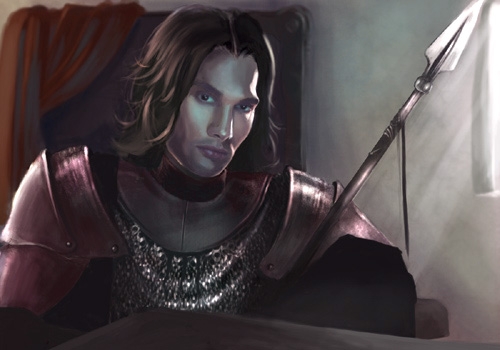 |
| Oberyn Martell, the Red Viper (Artist: Natascha Roeoesli). |
Oberyn’s protective instincts for his daughters likely arose from Oberyn’s one failure to protect those he loved: his sister Elia, and her children. Was his beloved sister Oberyn’s first lover? We readers are left to wonder. Oberyn convinced his elder sister to reject all the Dornish suitors their ruling mother brought for consideration; so impossible was a Dornish match, the siblings were sent to Casterly Rock to meet the Lannister twins as an alternative. I speculate that Joanna Lannister and the Princess of Dorne in their close friendship had shared concerns about their children’s too-close relations, and it was decided between them to make the best of it by throwing the four of them together into arranged marriages and letting them pair up as they saw fit. These plans, if such they were, were derailed at Joanna’s death and superseded by Tywin’s dynastic ambitions to make Cersei queen. Certainly Oberyn believes that Tywin bore his sister a grudge when she took the place Tywin expected for one of his own.
Tywin’s grudge was a little thing though compared to the tenacious lust for revenge that grew within Oberyn after the sack of King’s landing - but that was years away for the young Oberyn. Oberyn did not take a partner when his sister married Prince Rhaegar; perhaps, like Jaime Lannister, being brother in law to the king was enough for him. Was Oberyn as devoted to Elia as Jaime was to Cersei? Apparently not, as unlike Jaime, Oberyn was off on his adventures (amorous and otherwise). And what friendship did Oberyn have with his brother-in-law, Rhaegar? Did they come to some understanding that allows Oberyn to forgive - or even facilitate - whatever happened between Rhaegar and Lyanna? Note that as much as Oberyn rages against the Lannisters, he has no venom for Rhaegar, who left Elia and her children undefended.
While Oberyn was away - in pursuits unexplained and unaccounted for - his sister is raped and murdered and his niece and nephew are slaughtered by Gregor Clegane, a guy who enjoys this kind of thing. Oberyn, once back on the scene, rallies Dorne to call for revenge; his brother Prince Doran receives a visit from Lord Arryn which halts the effort. Tywin, in response to accusations from Dorne, frustratingly has plausible deniability in that he contends he did not order Elia’s death, he merely neglected to put orders in place to prevent it. And thus Oberyn’s resilient heart grieves.
Being a Martell, his heart is not broken - Oberyn’s family words provide solace - unbowed, unbent, unbroken. He hones his grief into an instrument of vengeance directed at his sister’s killer and bides his time, waiting patiently until the opportunity presents itself. When it does, with an offer to join the Small Council and get justice, he eagerly accepts. Once in King’s Landing, Oberyn will not set aside his need for revenge - and the longer he hears the Lannister’s futile efforts to placate him, the more impatient he becomes. When the chance comes for him to find justice in defending Tyrion Lannister, he takes it.
Oberyn’s patience reasserts itself during the duel. He steadily whittles away Gregor’s strength, seeking a confession - he taunts his adversary repeatedly: "You raped her. You murdered her. You killed her children." The incessant patter, a’la Inigo Montoya’s in the Princess Bride, grates on the Mountain and, unbelievably, unsettles him from what would assume is a calloused moral state. The duel between them is epic; the fast-moving, acrobatic and deadly accurate poisoner matched against the brutal strength and defensibility of a heavily armoured knight with no ethics. A reader could be forgiven for getting caught up in the scene, believing vengeance would be served in just fashion, and an unrepentantly evil character would receive an overdue comeuppance. Alas, this is George Martin and such tidy conclusions are not for his readers. Oberyn manages to pin Gregor like a bug on a collector’s board, yet despite this Gregor rallies and brutally crushes Oberyn’s face with his hand, confessing at the last that Elia had the same treatment from him.
Oberyn is a man whose life was defined by the women he loved; his mother, his daughters, his lovers, his sister. By all rights he was expected to die happily in bed with a woman. Instead, he has a warrior’s death from a hateful man, unlikely to have heard the confession he died to extract.
This post published at Tower of the Hand as part of the Top 30 Characters profiles.


 Any novelist who can turn the reader's ignorance to advantage has my respect; Sara Gruen does it by using the reader's ignorance to highlight the wet-behind-the-ears naivete of her protagonist, Jacob. She also turns the reader's forgetfulness to advantage, letting the protagonist's uncertain remembrances guide the reader through the story.
 about circus life this past summer, it was a lovely summer read. The story follows Jacob Jankowski's memories of his life as a young man. In his memories, he is transitioning from a young man's college life to a life on the road as a traveling vet for a circus; in the present time of the novel, he is an old man transitioning gradually into extreme old age.

 to a discourse on modern internet discussions, are conveyed in a slightly offhand, smarter-than-thou manner which is off-putting rather than engaging. For example, from David Denby:
 to ponder:
 by
by 

![Reblog this post [with Zemanta]](https://lh3.googleusercontent.com/blogger_img_proxy/AEn0k_uS0CELx-4qJmKwmgUVCDnRjjljJyjBENbwUo1_B0EoU2IQWlawTZEtRjlqAfYUWQCnZUzYLoCS7jlVBPyF0v1EIdIWxYD8wDc2bEJd1m1a9uA_fRZ-hyRWVLq28-8edQIaf2wF_4VpElm3EgO3z_vl=s0-d)


 Posts
Posts


