30 December 2010

Thousands of leaves from a thousand autumns

KYOTO, JAPAN - DECEMBER 04:  Togetsukyo Bridge...Image by Getty Images via @daylife
Today the snow is melting in Indianapolis and it reminded me of a book I'd read but not blogged about yet: The Thousand Autumns of Jacob De Zoet by David Mitchell. This book takes a compelling historical incident involving the Dutch East India Company's trading post on the island of Deijima, their limited actions with the Japanese, and the appearance of an English ship in the harbor.

The story begins initially with a young Japanese medical student, Orito, a woman of noble birth who has a face scarred from burns. She faces a kidnapping, forcible drugging, and forced service before attaining some redemption later, and on her own terms.

Orito gains the attention of Jacob De Zoet, a young man seeking to make his fortune with the Dutch East Indies Company before returning home to Zeeland.  Jacob is struggling to live morally in this outpost far from the stolid community he comes from, amongst men of uncertain character. As he wrestles with his conscience, he is punished for each decision he makes which is right. In a pivotal scene, his ability to persevere in a course he deems right is essential, though, and serves to keep the Dutch flag flying in Dejima for the years when the Dutch flag was flown nowhere else in the world.

A third character, Uzaemon, offers the last leg of the love triangle. He is a translator and scholar, and moves in waters with deep predators whose cunning he cannot fully see. The outcome, while sad, was predictable.
The Thousand Autumns of Jacob de Zoet: A Novel

The historical background research for this work must have been extensive, but the author's burden is not onerous to the reader.  Instead the international dynamics between English-Dutch-Japanese percolate along slowly and unobtrusively, until boiling over such that the characters react with precision. I admire Mitchell's ability to use such rich historical narrative without letting it overwhelm the fundamental story.
Enhanced by Zemanta

28 December 2010

The fast gourmet cookbook

The fast gourmet cookbook by Poppy Cannon

5.0 out of 5 stars Simple genius in the kitchen, December 28, 2010
This cookbook was a wonder-trove of information on how to pull together an apparently-from-scratch gourmet meal using readily available products and items from a local store. I'm shocked that this book isn't more widely available as her recipes are wonderful for use by busy cooks in any age, who want to serve something better than take-out. The recipes are varied and multinational. As an example, she has a tasty recipe for black-cherry chicken that uses a grocery-store rotisserie chicken, marjoram, and a can of black cherries to make a wonderfully savory dish in less than 10 minutes. If I had only two cookbooks ever I would have Joy of Cooking: 75th Anniversary Edition - 2006 and this book from Poppy.

13 December 2010

Bran Stark featured at Tower of the Hand

“The stone is strong, Bran told himself, the roots of the trees go deep, and under the ground the Kings of Winter sit their thrones. So long as those remained, Winterfell remained. It was not dead, just broken. Like me, he thought. I'm not dead either.” - Bran VII, A Clash of Kings
Bran Stark from HBO's Game of Thrones

In the North, for ages gone and many winters past, it appears that change comes not often. The Starks rule the North a thousand miles from King’s Landing to the south; their castle has stood for 8,000 years since it was raised by Bran the Builder. The cold lands lead to a staid people, unlikely to change often or easily - or so we would expect.


Not all is as it seems. Certainly not for a winter-lands child who can name his wolf Summer.


The Starks have wolf-blood,  even down through the last Stark in Winterfell - Bran the Broken. Bran’s capabilities are unknown to him, though, until he is crippled, by Jamie Lannister, when Jamie shoves Bran out a high tower window.  Bran spends weeks in a coma, watched over by his mother, Catelyn Stark, and guarded by Summer (and perhaps kept alive by the direwolf as well) - though the extent of Summer’s efforts are unknown until the wolf stymies an assassin.


Summer and Bran become closer still as Bran wakes from his coma and develops his warging abilities. Soon Catelyn heads South, Robb rides to war and Bran takes command of Winterfell, meeting with the Stark vassals and planning with his advisors for winter. He frets the whole time though that he will never be enough for the role; that as a cripple he is washed up. His dreams of knighthood evaporate, and he mourns their loss. How pitiful to see a child facing losses that would undo even a brave man. Fortuitously, then, the Reed siblings arrive to guide him, protect him, and shepherd him to a new life beyond the wall, to the three-eyed crow. Bran sets aside his childish dreams for truer dreams..


Westeros is changing - the North is changing - and who better to lead the North than a boy who can change not only his dreams of knighthood but even his very skin? Superficially, he is a paralyzed boy unable to sit a horse without a special saddle - but once we move beyond the surface of things, we find a boy who can be a giant with an unorthodox batte-cry of "Hodor!" or a wolf with an intelligent gaze. While there is some debate as to whom Robb Stark may have named as heir, or whether Jon Snow could accept and hold Winterfell, there is no debate as to who the last Stark was to sit in the high hall; that was Bran.  It was he also that knew Winterfell in and out, from up and down, and knew its passages and walls better than anyone. Bran has long odds to beat in just surviving in such a harsh land. But if you are already known as dead, perhaps survival will be easier.There is not much room for cripples in Westeros at war anyway.


Bran's fall and survival presages the fate of the Starks; they will fall, but rise again, fundamentally changed. Bran’s fate awaits him beyond the black gate with Coldhands; “the Black Gate, Sam had called it, but it wasn’t black at all.” Of course it wasn't black. Nothing, in this unchanging land, is really what it seems.

---
This post published at Tower of the Hand as part of the Top 30 Characters profiles on 12/7/2010. A previous character profile on Oberyn Martell was published on 11/22/2010.

22 November 2010

Oberyn Martell profile featured at Tower of the Hand


Oberyn Martell is the heart’s desire of many a lady in the Seven Kingdoms, and the heart’s bane of many a lord. The earliest conquest the reader knows of results in a duel between 16 year old Oberyn and Lord Yronwood over the affections of Lord Yronwood’s lover, and it does not end well for the Yronwoods with their Lord dying of festering wounds. Could these wounds have festered from some additive on Oberyn’s blade? He never claimed that, but earned the name Red Viper for the rumor.  His amorous ways have resulted in fine rewards for him; eight daughters, all in good relations with their father.

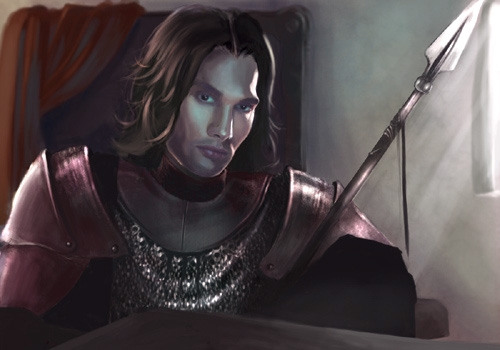
Oberyn Martell, the Red Viper (Artist: Natascha Roeoesli).
The oldest four of these sand snakes have different mothers. And why would they not? Oberyn took a partner in each place he took himself, and his daughters reveal the diversity of the man. The eldest was born to a whore of Oldtown. The next to a noblewoman across the ocean in the free cities. Third born was to a septa, who are generally a chaste lot. Fourth was to a Summer Isles trader. Most of the Westerosi abide by class distinctions without remark; Oberyn, instead, moves amongst all these groups with ease, and not just superficially - but with enough engagement to form relationships and keep them even after his affections have moved on. Oberyn’s parental devotion assures that even the lowest-born of these by-blow girls are raised into trades and cared for. Contrast that with another man known for his bastards, Robert Baratheon. Robert’s bastards are fathered and killed off in the very city where he sits the throne, and he is ignorant of their demise. One doubts that Oberyn would have let any of his daughters face such malice unprotected.  Notably, Oberyn’s wandering lusts find harbor in one woman: the mother of his fifth daughter, and all those thereafter: Elia - namesake, one assumes, of his deceased sister.

Oberyn’s protective instincts for his daughters likely arose from Oberyn’s one failure to protect those he loved: his sister Elia, and her children. Was his beloved sister Oberyn’s first lover? We readers are left to wonder. Oberyn convinced his elder sister to reject all the Dornish suitors their ruling mother brought for consideration; so impossible was a Dornish match, the siblings were sent to Casterly Rock to meet the Lannister twins as an alternative. I speculate that Joanna Lannister and the Princess of Dorne in their close friendship had shared concerns about their children’s too-close relations, and it was decided between them to make the best of it by throwing the four of them together into arranged marriages and letting them pair up as they saw fit. These plans, if such they were, were derailed at Joanna’s death and superseded by Tywin’s dynastic ambitions to make Cersei queen. Certainly Oberyn believes that Tywin bore his sister a grudge when she took the place Tywin expected for one of his own.

Tywin’s grudge was a little thing though compared to the tenacious lust for revenge that grew within Oberyn after the sack of King’s landing - but that was years away for the young Oberyn. Oberyn did not take a partner when his sister married Prince Rhaegar; perhaps, like Jaime Lannister, being brother in law to the king was enough for him. Was Oberyn as devoted to Elia as Jaime was to Cersei? Apparently not, as unlike Jaime, Oberyn was off on his adventures (amorous and otherwise). And what friendship did Oberyn have with his brother-in-law, Rhaegar? Did they come to some understanding that allows Oberyn to forgive - or even facilitate - whatever happened between Rhaegar and Lyanna? Note that as much as Oberyn rages against the Lannisters, he has no venom for Rhaegar, who left Elia and her children undefended.

While Oberyn was away - in pursuits unexplained and unaccounted for - his sister is raped and murdered and his niece and nephew are slaughtered by Gregor Clegane, a guy who enjoys this kind of thing. Oberyn, once back on the scene, rallies Dorne to call for revenge; his brother Prince Doran receives a visit from Lord Arryn which halts the effort. Tywin, in response to accusations from Dorne, frustratingly has plausible deniability in that he contends he did not order Elia’s death, he merely neglected to put orders in place to prevent it. And thus Oberyn’s resilient heart grieves.

Being a Martell, his heart is not broken - Oberyn’s family words provide solace - unbowed, unbent, unbroken. He hones his grief into an instrument of vengeance directed at his sister’s killer and bides his time, waiting patiently until the opportunity presents itself. When it does, with an offer to join the Small Council and get justice, he eagerly accepts. Once in King’s Landing, Oberyn will not set aside his need for revenge - and the longer he hears the Lannister’s futile efforts to placate him, the more impatient he becomes. When the chance comes for him to find justice in defending Tyrion Lannister, he takes it.

Oberyn’s patience reasserts itself during the duel. He steadily whittles away Gregor’s strength, seeking a confession - he taunts his adversary repeatedly: "You raped her. You murdered her. You killed her children." The incessant patter, a’la Inigo Montoya’s in the Princess Bride, grates on the Mountain and, unbelievably, unsettles him from what would assume is a calloused moral state. The duel between them is epic; the fast-moving, acrobatic and deadly accurate poisoner matched against the brutal strength and defensibility of a heavily armoured knight with no ethics. A reader could be forgiven for getting caught up in the scene, believing vengeance would be served in just fashion, and an unrepentantly evil character would receive an overdue comeuppance.  Alas, this is George Martin and such tidy conclusions are not for his readers. Oberyn manages to pin Gregor like a bug on a collector’s board, yet despite this Gregor rallies and brutally crushes Oberyn’s face with his hand, confessing at the last that Elia had the same treatment from him.

Oberyn is a man whose life was defined by the women he loved; his mother, his daughters, his lovers, his sister.  By all rights he was expected to die happily in bed with a woman. Instead, he has a warrior’s death from a hateful man, unlikely to have heard the confession he died to extract.

This post published at Tower of the Hand as part of the Top 30 Characters profiles.